

MEMORIAL GARDENS
Kingston Council and Kingston First are continuing their partnership to transform spaces across the town centre into places where everyone can unwind, enjoy and connect with nature.
Thank you to everyone who took the time to share their thoughts on the draft plan. The developed design aims to respect the space as a garden of memory and its cultural significance for commemoration and ceremony, whilst improving connectivity, safety, and inclusivity, to ensure the space is welcoming to all residents and visitors.
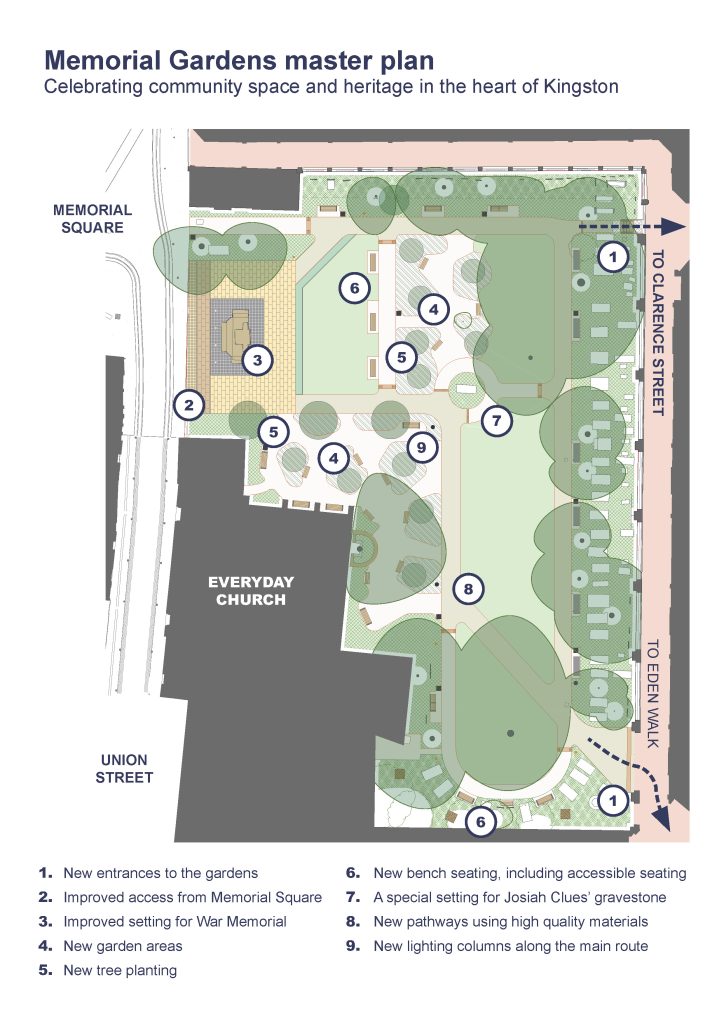
Communities are set to enjoy improved connectivity and accessibility, with new pathways from Eden Walk and Pratts Passage, upgraded lighting and enhanced green space with more trees, planting and seating areas.
Enhancements will also highlight and improve the setting of important heritage assets, including the War Memorial and the gravestone of Josiah Clues, a Lieutenant in the British Army who served in the Battle of Waterloo.
The planning application for the improvement works has been approved and an award-winning landscape specialist contractor, Blakedown Landscapes, has been appointed to carry out these important works. Regular updates will be posted on the site noticeboard.
Work will begin on site in early January and is due to complete by late spring 2026.
Memorial Gardens has been a key green space at the heart of Kingston Town Centre for centuries. Two hundred years ago (in 1826), it was set out as an overflow burial ground for All Saints Church. One hundred years ago (in 1923), the War Memorial was unveiled and created the garden of commemoration that it is today.
Memorial Gardens offers a place for quiet contemplation and reflection amongst green lawns, trees, and gardens. However, the gardens suffer from a lack of tidiness and litter and a lack of connectivity to the surrounding town centre.
The proposed improvements to Memorial Gardens will increase the amount of trees and garden planting. New points of access to Eden Walk and Pratts Passage will improve connections and encourage more people to move into and through the space.
New pathways and lighting will also draw people into the space. This will increase feelings of safety and inclusion, ensuring that the gardens are an inviting space for all users – day and night.